

Real productivity isn’t about wringing every last drop of sweat out of your workday. It’s about taking the wheel so you can lead a focused, low-stress, and fulfilling life.
Too many of us fall into the trap of endless busyness, confusing frantic motion with actual progress. We spend our days answering messages, putting out minor fires, and plowing through to-do lists, only to hit 5:00 PM and realize our most important goals didn’t get a single second of attention.
To step off that hamster wheel, you have to treat your time for what it really is: your most valuable, non-renewable resource. Here is a down-to-earth guide to rebuilding your schedule and making habits stick.
Simple Strategies to Protect Your Schedule
Most time management attempts fall flat because they rely on sheer willpower. The trouble is, willpower runs out fast as the day wears on. Instead of trying to force yourself to concentrate through grit alone, build physical and mental guardrails using these core frameworks.
The Baseline Audit: Find Your Time Leaks
You can’t fix a schedule if you don’t know where it’s leaking. Before jumping into a new system, take a honest look at where your hours actually vanish.
For the next three days, track your time in 30-minute chunks. Write down everything: deep focus work, quick team check-ins, social media scrolling, coffee breaks, or staring blankly at a wall. Most people are amazed by the gap between where they think their time goes and where it actually goes. You might feel like you spent four solid hours on a project proposal when you really spent two hours working and two hours jumping between browser tabs and group chats.
┌──────────────────────┬──────────────────────────────────────────────┐
│ WHAT YOU ASSUME      │ WHAT ACTUALLY HAPPENS                        │
├──────────────────────┼──────────────────────────────────────────────┤
│ 4 hours of deep focus│ 1.5 to 2 hours of actual focused work        │
│ Quick inbox check    │ 45 minutes lost to app-switching & chatter   │
└──────────────────────┴──────────────────────────────────────────────┘
Ditch the Infinite To-Do List for Time Blocking
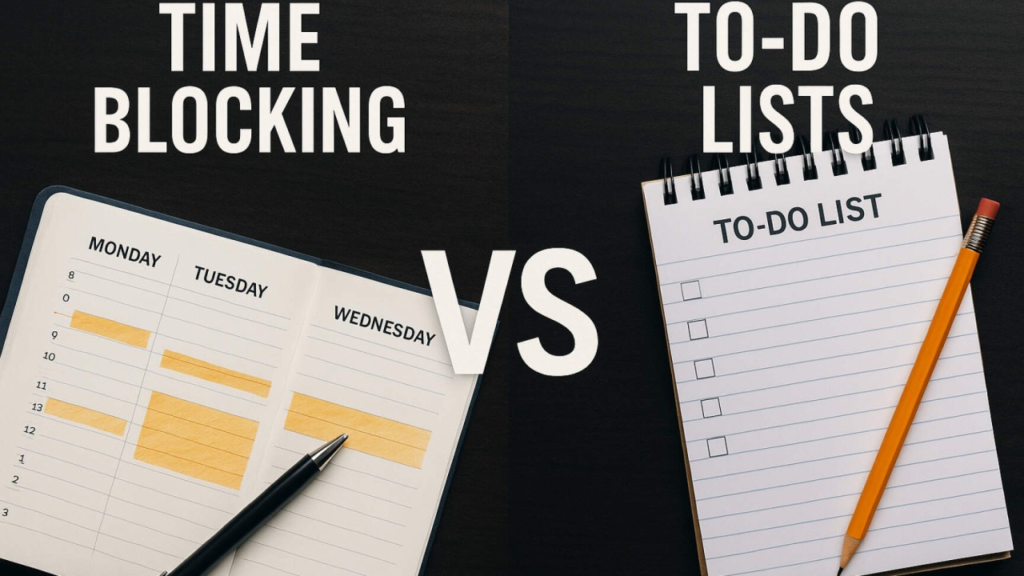
Standard to-do lists have a big flaw: they treat a quick two-minute task with the exact same weight as a complex, three-hour project. Your brain naturally picks the path of least resistance, knocking off the easy stuff while the high-impact work sits at the bottom untouched.
Time blocking solves this by pairing your tasks directly with your calendar. Instead of putting “Draft marketing plan” on a running list, block off an actual slot: Tuesday, 9:00 AM – 10:30 AM: Marketing Plan. This shifts your mental state from “What should I do next?” to “It’s 9:00 AM, so this is what I’m doing right now.” If it doesn’t have a spot on the calendar, it doesn’t happen.
The Eisenhower Matrix: Sort the Signal from the Noise
To keep your time blocks safe, run incoming demands through a quick four-way filter:
- Urgent & Important (Do Now): Crises, tight deadlines, or emergency fixes that demand immediate attention.
- Important, Not Urgent (Schedule It): This is where real progress happens—long-term planning, skill building, exercise, and relationships. High performers protect this space before these items turn into urgent fires.
- Urgent, Not Important (Delegate): Constant ping notifications, non-essential emails, and status meetings that could be a text. Hand these off or automate them where possible.
- Neither Urgent nor Important (Cut It): Doomscrolling, mindless channel surfing, and trivial busywork. Snip these out of your core hours.
Daily Habits That Run on Autopilot
If a good schedule is your blueprint, strong habits are the actual bricks. Solid habits take basic choices off your plate, preserving mental bandwidth for creative and heavy-duty problem-solving.
┌─────────────────┬────────────────────────────────────────────────────────┐
│ HABIT FOCUS     │ ACTIONABLE STEP                                        │
├─────────────────┼────────────────────────────────────────────────────────┤
│ First 90 Mins   │ Keep screens away to protect your early momentum       │
│ Habit Stacking  │ Attach a new goal onto a routine you already do daily  │
│ Focus Blocks    │ Hide your phone away to keep your brain in the zone    │
└─────────────────┴────────────────────────────────────────────────────────┘
Own Your First 90 Minutes
How you start your morning sets the baseline for your entire day. Reach for your phone the second you wake up, and you instantly surrender control. You throw your brain straight into a reactive loop, absorbing other people’s problems and priorities before you’ve even poured a glass of water.
Set a boundary around your first hour or two. Use this window for things that ground you and push your personal priorities forward—whether that’s a workout, reading, journaling, or tackling your single biggest work task while your mind is completely fresh. Winning the morning gives you momentum that carries you right through afternoon distractions.
Use Habit Stacking to Cut Mental Resistance

Trying to build a new habit out of nowhere is tough because your brain hates extra friction. You can work around this by using habit stacking—hooking a brand-new habit directly onto something you already do every day without thinking.
The formula is super straightforward: After I [Current Habit], I will [New Habit].
- “After I pour my morning coffee, I will write down my top three goals for the day.”
- “After I shut my laptop at the end of the day, I will take five minutes to clear off my desk.”
By piggybacking on a routine your brain already knows, you skip the willpower struggle of trying to remember the new task.
Step Away from Digital Distractions
Modern devices are carefully crafted to fragment your attention span. Every notification drop triggers a tiny hit of dopamine that pulls you out of deep focus. In fact, it often takes over 20 minutes to get back into the zone after a single interruption.
When it’s time for heavy focus work, practice real digital decoupling. Move your phone into another room—even lying face-down on your desk, it steals subconscious attention as you actively resist picking it up. Turn on site blockers and close your email tabs. Give yourself clean, quiet windows of time so your brain can dive deep without being dragged back to the surface.
Managing Your Energy and Emotional Friction
Even the slickest productivity setups hit snags like procrastination, perfectionism, or plain burnout. To keep moving forward, you need practical strategies for handling those mental roadblocks.
Lower the Drag with the 2-Minute Rule
Procrastination usually strikes right at the starting line. When a project looks huge, your brain panics and looks for an escape route. You can break that initial freeze using the 2-Minute Rule: make the absolute first step take less than two minutes.
Instead of telling yourself to “write an entire article,” commit to writing just two sentences. Instead of worrying about a “brutal one-hour workout,” just put on your sneakers and walk out the door. Once you get past that initial inertia, the friction vanishes. Action builds clarity, and momentum takes over.
Work with Your Energy, Not Against the Clock
Time stays fixed at 24 hours a day no matter what. Energy, on the other hand, goes up and down constantly. Matching your workload to your energy levels is far more effective than trying to manage the clock.
Pay attention to your body’s natural rhythms throughout the day:
| Time Window | Energy State | Best Uses | Real-World Examples |
|---|---|---|---|
| Morning (9:00 AM – 12:00 PM) | High / Focused | Heavy Problem Solving | Strategy, writing, complex analysis |
| Early Afternoon (1:00 PM – 3:00 PM) | Post-Lunch Slump | Low-Brainpower Tasks | Clearing inbox, sorting files, basic admin |
| Late Afternoon (3:00 PM – 5:00 PM) | Moderate Recovery | Creative / Interactive | Team check-ins, brainstorming, learning |
If you’re sharpest in the morning, don’t waste those golden hours clearing out routine emails or sitting through low-stakes meetings. Save that high-energy window for your toughest, most strategic work. When your energy dips in the afternoon, pivot to lighter tasks like organizing files or cleaning up your inbox.
The Reset Button: The Weekly Review
A good productivity system isn’t something you set up once and leave on autopilot forever. It’s a living routine that needs tweaking. The Weekly Review is the bridge that keeps your everyday tasks tied to your bigger goals.
Block off 30 minutes every Friday afternoon or Sunday evening for a simple reset. Clear your desk, look over your calendar, and answer three quick questions:
- What went well this week? Note your wins, see which habits clicked, and celebrate real progress.
- Where did I get stuck? Pinpoint exactly when you lost focus, procrastinated, or let minor distractions pull you off track.
- What am I adjusting for next week? Scan your upcoming calendar, reserve slots for your main goals, and fix any environmental traps that tripped you up this week.
This simple habit keeps you from drifting. It turns small mistakes into useful feedback, helping you fine-tune your workflow week after week.
FAQ’s
1. What is the best way to improve productivity?
Set clear priorities, reduce distractions, and focus on one important task at a time.
2. How can I manage my time better?
Create a simple schedule, prioritize important tasks, and set realistic deadlines.
3. How can I avoid distractions while working?
Turn off unnecessary notifications, keep your workspace organized, and use focused work sessions.
4. Are productivity tools useful?
Yes. Task managers, calendars, note-taking apps, and time-tracking tools can help you stay organized.
5. How can I stay productive without feeling overwhelmed?
Break large tasks into smaller steps, take regular breaks, and avoid setting unrealistic daily goals.