

Being truly productive isn’t about packing every single hour of your calendar with endless tasks, nor is it about grinding until you hit complete burnout. Real efficiency comes down to working with intention—focusing your best energy on the few things that genuinely move the needle, while quietly cutting away the background noise that drains your focus.
Most of us know the frustration of working continuously from morning to night, only to close our laptops feeling like we barely accomplished anything meaningful. That feeling rarely comes from a lack of effort. More often, it is the result of fragmented focus, constant notifications, relentless multitasking, or simply trying to juggle too many competing priorities at once.
The good news is that sustainable productivity doesn’t require complex software, rigid habit tracking, or a total lifestyle overhaul. Making a few intentional adjustments to how you plan your morning, guard your focus, and structure your workspace can help you make consistent progress, lower your stress, and reclaim hours of free time every single day.
Core Productivity Frameworks
Before diving into daily tactics, it helps to set up a simple structure for your day. A solid framework cuts through mental clutter and ensures your actions line up with your actual priorities rather than immediate distractions.
                  DAILY FOCUS FLOW

  [ Morning Priority ]  ---> Execute Most Important Task first
           |
           v
  [ Structured Blocks ] ---> Single-task during high-energy windows
           |
           v
  [ Low-Friction Admin ] -> Batch quick tasks via the 2-minute rule
           |
           v
  [ Evening Reset ]     ---> Review progress & select tomorrow's goal
Start With Your Most Important Task
Before opening your inbox, responding to instant messages, or letting social media dictate your attention, isolate the one core task that matters most for your day. Ask yourself a simple question: “If I could only cross one key item off my list today, which one would make the biggest impact?”
Starting your morning with this primary objective gives your day clear direction right out of the gate. It protects your peak mental energy for high-impact work instead of letting those fresh early hours get swallowed up by low-value administrative chores that could easily wait.
Categorize Your Priorities Simply
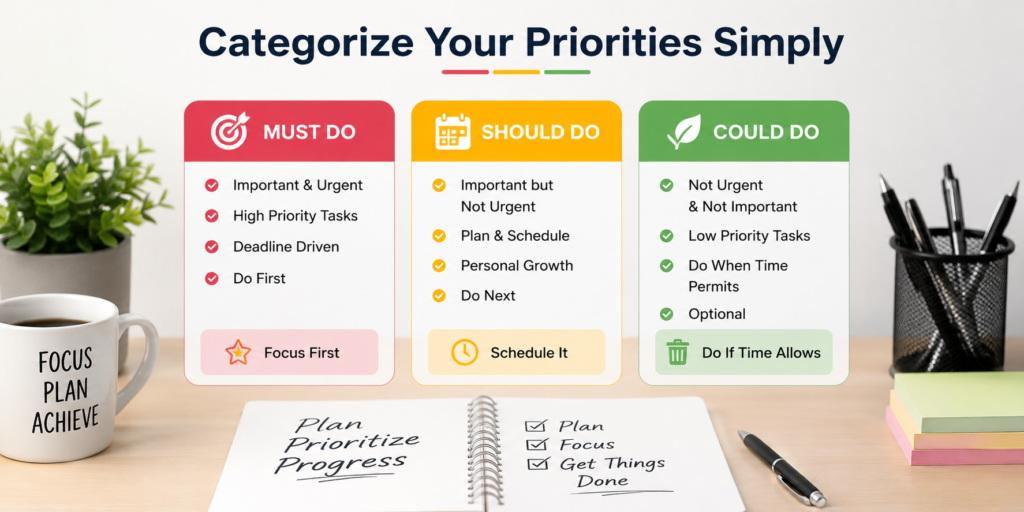
A massive to-do list where every single bullet point is flagged as “urgent” is a direct path to decision fatigue and procrastination. When everything seems critical, nothing gets your full attention. To keep your workload manageable, organize your daily commitments into three distinct buckets:
- Must Do: The non-negotiable tasks that carry firm, immediate deadlines or significant real-world consequences if left undone.
- Should Do: Important projects and strategic goals that move your long-term work forward, but have a bit of flexibility on timing.
- Could Do: Low-stakes tasks, quick admin chores, or optional ideas that you can tackle if you finish your primary goals early.
Transition to Single-Tasking
Multitasking often feels productive in the moment, but brain research shows that constantly jumping between different tasks actively degrades your focus. Every time you switch from drafting a report to checking an email and back again, your brain leaves a trail of attention behind—a cognitive tax known as context switching.
Dividing your attention across multiple tabs, documents, or conversations leads to shallow work and mental fatigue. Instead, commit to single-tasking. Focus completely on one objective until you hit a natural stopping point, then take a breather before moving on to the next.
Practical Daily Strategies
Applying a few proven strategies directly to your work schedule helps build a reliable rhythm, making it much easier to drop into deep focus when you need to.
| Strategy | Implementation | Practical Daily Benefit |
|---|---|---|
| Time Blocking | Reserve specific, dedicated blocks on your daily calendar for different types of work (e.g., deep focus, team syncs, email catch-up). | Eliminates decision fatigue by laying out a clear visual roadmap of what to work on and when. |
| The 2-Minute Rule | If a minor task takes less than two minutes (e.g., confirming a meeting or archiving a file), handle it immediately. | Keeps small administrative items from piling up into an overwhelming, lingering to-do list. |
| Batch Processing | Group similar, repetitive activities together—such as answering all emails or making phone calls in one go. | Saves mental energy by preventing the constant gear-shifting required by scattered interruptions. |
| Focus Sprint (25 Min) | Work on a single task with zero interruptions for 25 minutes, followed by a mandatory 5-minute break. | Builds sustained concentration while embedding regular rest breaks to prevent mid-day burnout. |
Optimizing Environment, Energy, and Mindset
Your environment and internal energy levels play a massive role in how smoothly your work gets done. Optimizing these secondary factors creates a low-friction setup where staying focused becomes second nature.
Audit Your Smartphone Notifications
Push notifications are designed to break your concentration and pull you into endless scrolling loops. Every ping or banner creates a urge to check your screen, breaking your train of thought. Take a few minutes to customize your notification settings. Turn off non-essential alerts from social media apps, games, news outlets, and shopping platforms, keeping only essential phone calls and priority messages active. A quieter phone instantly leads to a calmer, more focused mind.
Design a Low-Friction Workspace
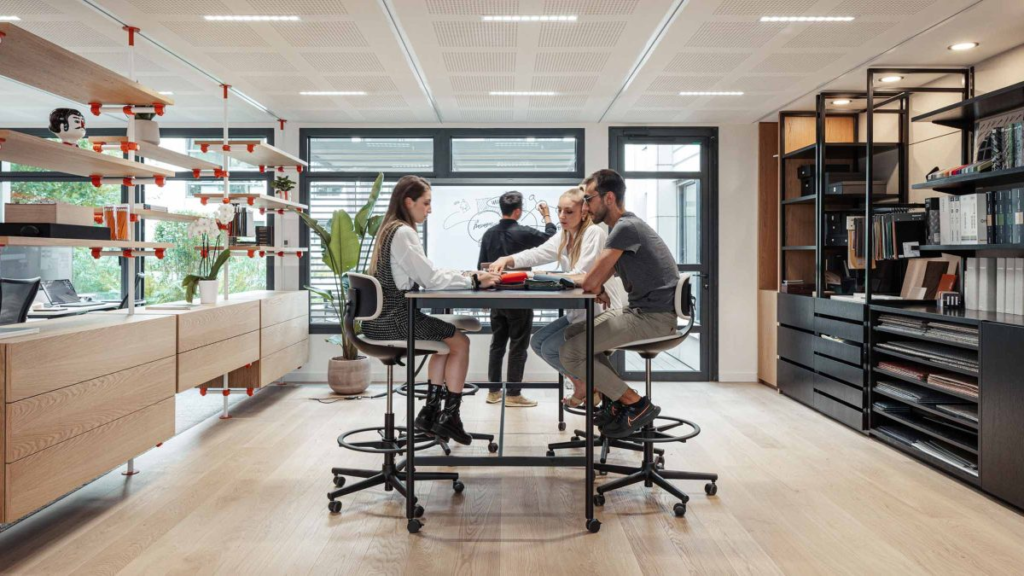
Physical and digital clutter quietly compete for your brain’s limited processing power. Before diving into critical work, take two minutes to clear your physical desk of unnecessary items and close extra browser tabs that aren’t related to the task at hand. Keep active project files neatly organized in clear, descriptive folders. A clean workspace lowers visual friction, making it significantly easier to dive straight into deep, uninterrupted concentration.
Build Reusable Templates for Routine Tasks
If your weekly routine involves writing similar project updates, client check-ins, or status reports, stop drafting them from scratch every time. Build a small library of standard templates for your most common documents and emails. Customizing a pre-written framework takes a fraction of the time and mental effort, letting you speed through repetitive tasks without sacrificing quality or accuracy.
Protect Your Natural Energy Peaks

Productivity isn’t just about managing hours; it’s primarily about managing your personal energy. Pay attention to your natural circadian rhythms over the course of a week. If you feel sharpest in the morning, block off those hours for complex analytical tasks, creative brainstorming, or difficult problem-solving. Save repetitive administrative tasks, routine emails, and casual check-ins for the late afternoon when your cognitive energy naturally dips.
Embrace “Good Enough” Over Perfection
Perfectionism is often procrastination in disguise. Spending endless hours polishing a minor document or fine-tuning a presentation past the point of diminishing returns wastes valuable time that could be spent elsewhere. Learn to recognize when a piece of work meets high standards of quality, finish it efficiently, and move forward rather than endlessly tweaking details that no one else will notice.
End Your Day With an Evening Reset
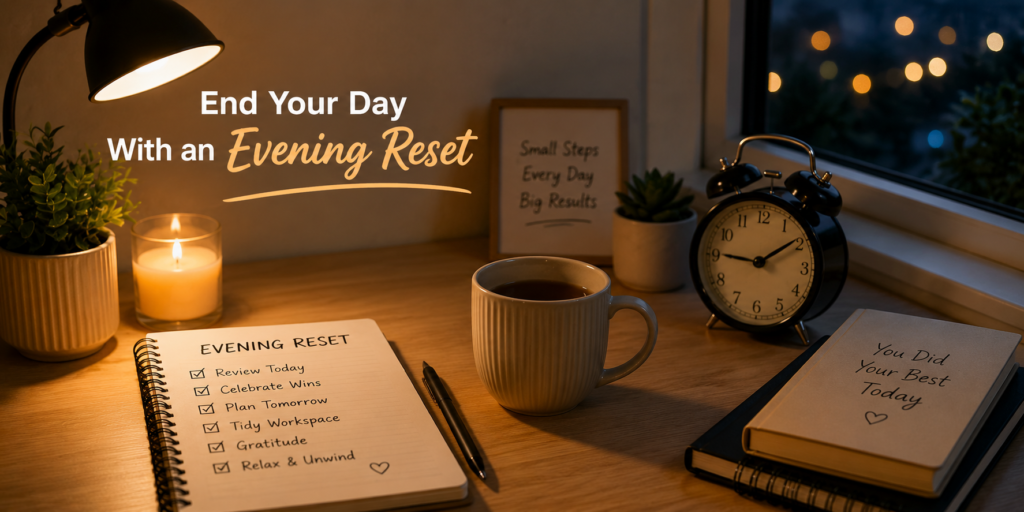
Close out every workday with a quick five-minute review. Look over what you accomplished, note any unexpected distractions that popped up, and explicitly choose your single most important task for the following morning. Writing down your game plan before you shut down your computer clears your mind, prevents work stress from bleeding into your personal evening, and sets you up to hit the ground running tomorrow.
Sustainable Progress Over Constant Hustle
At the end of the day, true productivity isn’t about turning yourself into a machine or squeezing every drop of output out of your schedule. It’s about building a balanced, sustainable workflow that lets you do meaningful, high-quality work without sacrificing your health, your relationships, or your peace of mind.
By choosing clear priorities, protecting your attention from unnecessary noise, and leaving room to step away and recharge, you stop simply reacting to the day’s demands. Instead, you gain total control over your time, making steady, reliable progress on what truly matters most.
FAQ’s
1. What are productivity hacks?
Productivity hacks are simple strategies that help you manage time, reduce distractions, and complete tasks more efficiently.
2. How can I improve my focus?
Reduce notifications, work on one task at a time, and take short breaks to refresh your attention.
3. Is multitasking good for productivity?
Usually not. Focusing on one task at a time can help reduce distractions and improve efficiency.
4. How can I save time every day?
Plan your priorities, group similar tasks, use shortcuts or templates, and avoid unnecessary interruptions.
5. What is the easiest productivity habit to start?
Choose your most important task each morning and complete it before moving on to less important activities.